This isn’t the first time Adrian Ashton has appeared on our blog as a Featured Freelancer. It’s been three years since we last interviewed Adrian and a lot has changed in this time. Read all about his journey and what’s changed for Adrian in the last three years…
What is your name and what do you do?
Adrian Ashton – and I’m not proud: if it involves getting paid, I’ll consider anything… But if you ask people who’ve worked with me what it is that I do, they’ll usually say it’s around helping organisations and groups of all types either fix issues that people are trying to avoid or making changes that seem too hard. And whilst that may sound a bit coach-y, I actually use enterprise and business development approaches.
How long have you been freelancing and why did you decide to become a freelancer?
This is my 15th year of ‘freeing my lance’, and I fell into it after being shafted on a career opportunity that meant I’d relocated my family to the other end of the country, and suddenly found myself without any employment or ability to pay the bills (or buy nappies for the new baby!).
What strategy do you find most effective for attracting new clients?
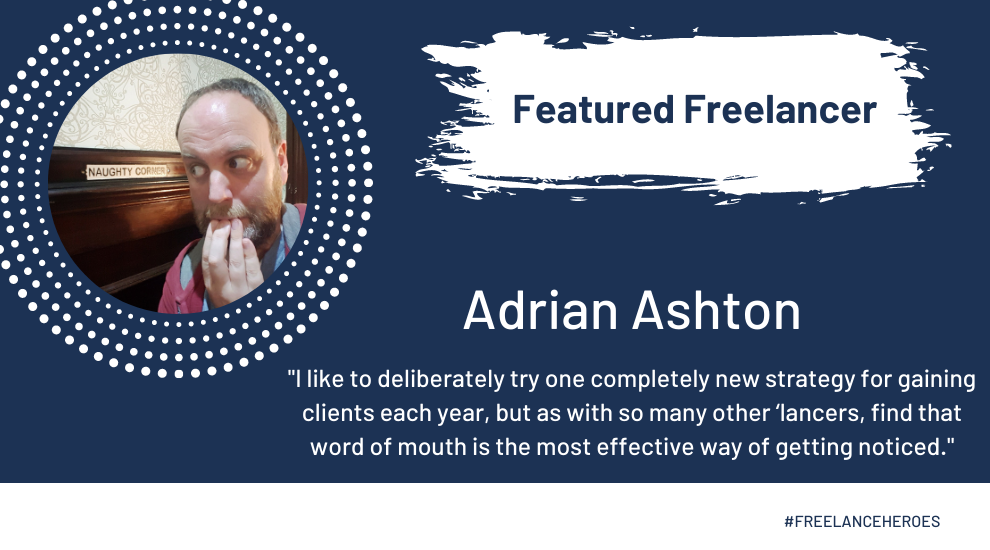
I like to deliberately try one completely new strategy for gaining clients each year, but as with so many other ‘lancers, find that word of mouth is the most effective way of getting noticed. And in the pre-social media age I started out in (the first iPhone was still several years off, being released onto the world in 2005), that meant a lot of hard graft, schmoozing, and hustling for about 6 years, before it started to pay off…
What app or social media platform could you not run your business without, and why?
LinkedIn has become my ‘must have’ social media platform – one of my ‘superpowers’ (according to clients) is that I’m like ‘spider-man’: not because I look good in skin tight lycra, but because I have ‘webs’ of connections and contacts that mean I can help assemble crack expert teams at the drop of a keyboard… Sadly my brain isn’t powerful enough to constantly be re-filing and re-indexing all the people in these various webs, so I’m always grateful LinkedIn is there to help me maintain my web-shooters.
Do you research prospects before a call or meeting? If so, what information do you look for?
If I’m having a conversation with someone for the first time, I’ve always stalked them first… LinkedIn profiles, latest tweets, that sort of thing (rather than sitting outside their house with a telescopic lens on my camera). It helps get a sense of what they’re involved/interested in, and offers some opening prompts for the conversation.
What do you do to help maintain positive mental wellbeing?
If anyone’s seen me on a zoom call, they’ll probably know that my favourite bottle of 10-year old single malt whisky is never far from my side… Now, I’m not advocating alcohol as a solution to helping positive mental well-being, but you can’t rush a good whisky, so it forces me to slow down, savour the taste, be in the moment, reset my perspective. And that’s all good.
I also potter with a bit of gardening (and always observe #WorldNakedGardeningDay).
Is being a freelancer what you expected? Do you work more hours (or less) than what you had first anticipated?
I always try and go into everything with an open mind (although not so open that everything falls out of it…). Something that I didn’t fully appreciate when I set out was just how powerful being a freelancer can make you: in not being bound by a ‘duty of care’ to an employer, I’ve been freer to speak out and challenge things. And along the way in doing so, I’ve ‘accidentally’ changed company law, influenced national policy, created new models of workspace that are helping people move out of being homeless, and such like. But on the flip side, it still sucks in not having holiday/sick pay, nor having someone else pay into a pension pot for me.
What are the most common objections you’ve had from potential clients? How did/do you overcome them?
“No budget” = a large part of my business model is to offer support through charity or government funded programmes, so clients-to-be don’t have to worry about choosing between buying me in, or being able to have biscuits at their next team meeting;
and “you haven’t got the right face” (the equivalent of my not having a specific certification, having the right legal form for a client to be able to contract with, or some such) = like Jim Phelps (or more recently, Ethan Hunt), I keep ‘dossiers’ of people and other organisations, so can quickly assemble a team that can tick off all the boxes needed.
Have you ever turned a prospect away? If so, why and how did you do it?
Yes – I never take on a client where I think that there may be someone I know who’s better placed to offer them the support they need (and I’ll exit with an introduction to them). But I’ve also ‘walked away’ mid job before too, if it becomes apparent that the clients circumstances have changed so that they now need someone other than me – and again, I’ll exit by handing the balance of the contract to that person (with some prior conversation and agreement all round).
What do (would) you do when a client ghosts you?!
As risky as this is to publicly reveal, I’ve never instigated legal recourse (and not sure I ever would) – doing so incurs a cost (in terms of both hard cash and opportunity lost elsewhere). And even if the court rules in your favour, you may then need to start again to get a payment order. It’s all too easy for clients to disappear legally, or hide behind company legislation (especially under the emergency corporate insolvency act that’s been introduced during the current pandemic circus).
It also goes against my trying to base everything on/in relationships – I’m always open with clients from the get go on any project that if their cash-flow starts to wobble, they just need to tell me, and we can have a proper conversation about we can do about it together.
Are your motivations now the same as they were when you started freelancing?
Yup – the driving force then remains true today: to support my family. And I work that out by not just making sure I can help to provide a roof, food, access to WiFi, etc – but also by trying to be part of things that will mean that the world is hopefully in slightly better shape for my kids as they grow up in it, than it might have been otherwise.
What is it about being a freelancer that you enjoy most?
Having calls with clients whilst hanging out laundry, being able to get involved in all sorts of adventures (the most interesting and provocative of which I’m not allowed to legally talk about publicly), and have you not seen the video of me doing business whilst wearing only my dressing gown?
What do you enjoy the least about being a freelancer?
Always wondering where the next client job is coming from; hoping that after the work has been won that the client doesn’t cancel it mid-way (the first national lockdown in March meant over 90% of all my client work got cancelled); and praying that even if I can complete the project, the client won’t then ghost me.
Also, the indignation that government consistently ignore us, despite the fact that we make up about 5 million people in the total economic workforce, and typically pay more tax on our earnings than salaried employees or company directors do.
What one thing do you wish you had known before you became a freelancer?
Clients are usually much keener than you might think to hold meetings in the pub. That, and you can never have too many back-up IT systems.
What is your ONE top tip or piece of advice you would offer to other freelancers?
100 (or even 10) years from now, no-one will remember the mistakes we made, or how foolish we felt at the time making them. So, take all the risks you can now – none of us are getting out of this life alive, so try and enjoy yourself as much as you can (assuming that, like me, you’re also trying to reach the final exit with the smallest body count possible…).
You can find out more about Adrian on his blog, as well as join Adrian on Facebook, Twitter and LinkedIn.
Visit our other Featured Freelancers here and, if you’re a UK freelancer, join us in our Facebook group.